The authors express their thanks to Antje Blättner and Susie Samuel for their contribution to this article.
Introduction
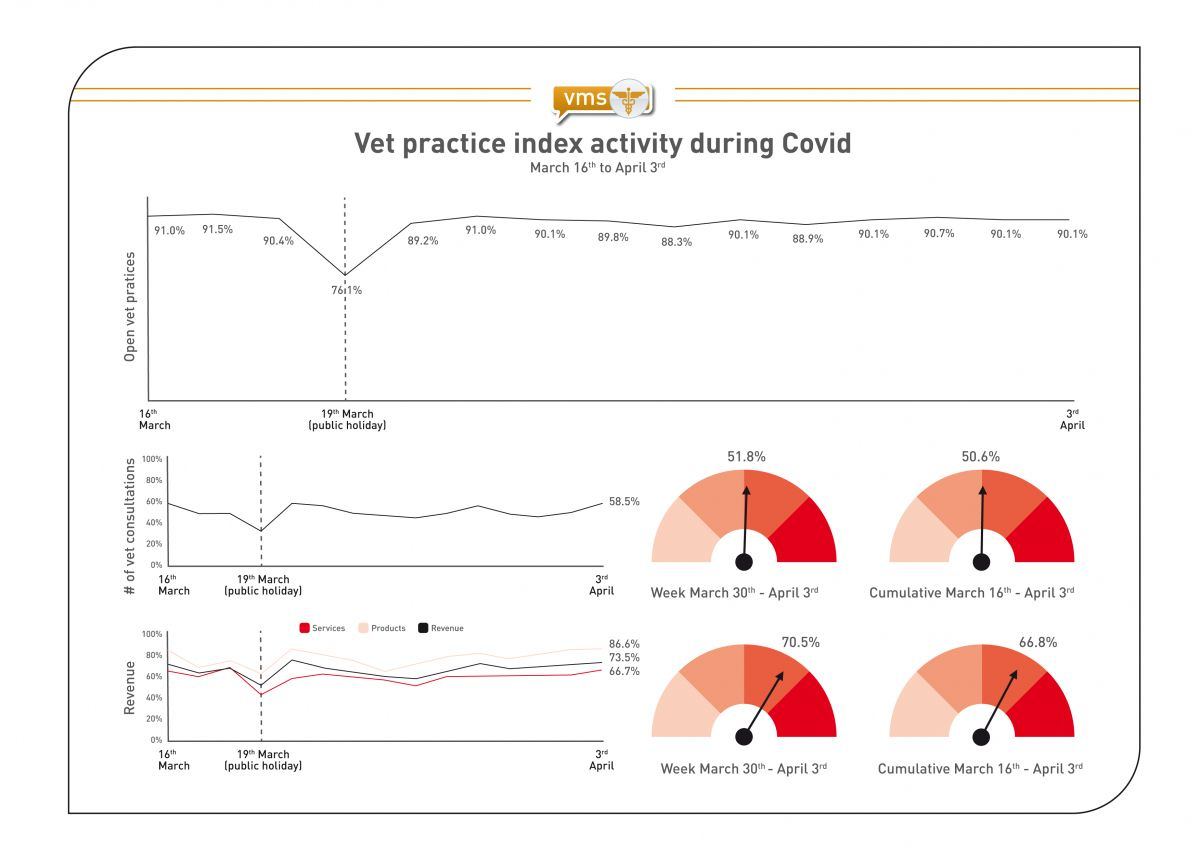
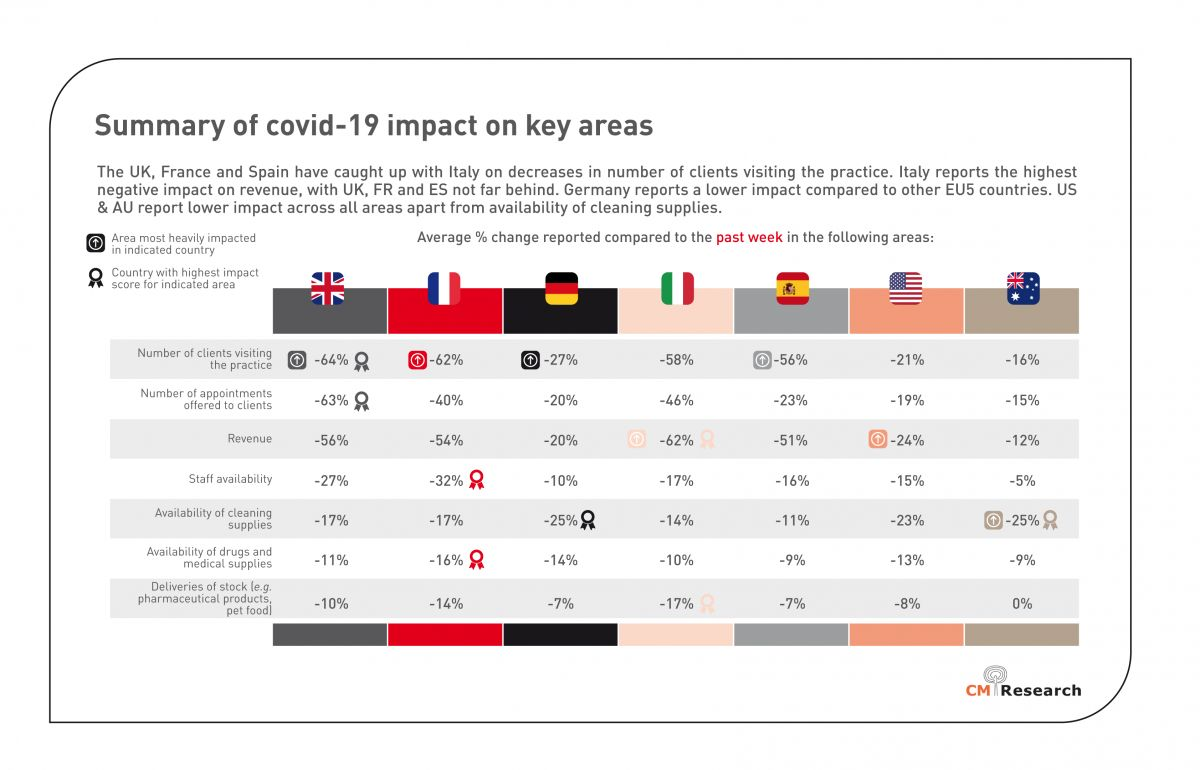
At the time of writing, we are only at the outbreak stage of the coronavirus pandemic, and varying degrees of confinement measures have been in place for a different number of weeks in different countries. What will be the financial impact of the virus and its consequences on veterinary practices in the short, medium and long term? It is still too early to have a clear understanding about what will happen, but some solid evidence has already emerged: according to the recent VMS COVID-19 report, which was based on a panel of 343 veterinary practices in Spain, total practice revenue decreased by an average of 33.2% in the three-week period starting March 16th 2020, with veterinary services also showing a worse performance than product sales (Figure 1). In a separate study performed by CM Research (coronavirus survey, wave 2: What is the impact of COVID-19 on veterinary professionals and their practices?) involving 870 vets from seven countries (US, UK, Australia, France, Italy, Spain and Germany), the week of March 27th saw a considerable decrease in practice revenue against the preceding week, ranging from a minimum of -12% (in Australia) to a maximum of -62% (in Italy) (Figure 2). In any case, it is clear that this pandemic is going to generate a serious revenue loss for veterinary practices, probably anywhere between 15% and 50%, and for an as-yet unknown duration.
The ability and focus of the practice management team to manage cash is critical in surviving this crisis.
Why are practices particularly vulnerable?
Veterinary practices throughout the world are at risk if there is a sudden drop in demand for their services, mainly because of what are call “fixed” costs. In most practices, the typical profit and loss structure (with some obvious variation between practice types) can be broadly split as follows (Table 1).
| % of income | Cost nature |
|
| Revenue | 100 | - |
| Merchandise & Supplies |
20 - 30 |
Variable |
| Payroll (owners and employees) |
40 - 50 | Fixed |
| Overheads (premises, administration, etc.) | 15 - 20 | Fixed |
| EBITDA * | +5 to 15% |
A cost is considered as “fixed” when it does not vary with the level of workload of the practice, at least in the short term (i.e., months or a year). Typical examples of this are the rent of the practice building or the size of the payroll, which will be the same (or very difficult to change) whether 20 or 100 pets enter the clinic on any given day. On the other side, the volume of goods and supplies purchased by the clinic will be more adaptable to the level of activity, meaning that if there are less clients for some weeks, the practice will buy less; these are variable costs.
A sudden, significant fall in revenue combined with poor cash management, rigid labor legislation and lack of financial support could kill a practice in a matter of weeks.
It is possible to alter Table 1 to show what the profit and loss structure of a clinic would look like using three different scenarios where revenue decreases by either 20%, 30% or 50%, as shown in (Table 2).
| Pre-crisis situation | 20% revenue drop |
30% revenue drop | 50% revenue drop | |
| Revenue | 100 | 80 | 70 | 50 |
| Merchandise & Supplies |
20 - 30 |
16 - 24 | 14 - 21 | 10/15 |
| Payroll (partners & employees) |
40 - 50 | 40 - 50 | 40 - 50 | 40/50 |
| Overheads (premises, administration, etc.) | 15 - 20 | 15 - 20 | 15 - 20 | 15 - 20 |
| EBITDA | +5 to +15 | -5 to -15 | -10 to -20 | -15 to -30 |
Are all practices affected to the same degree?
This is a difficult one to answer, as there is no previous experience in the veterinary sector of a sudden drop in demand as is happening currently. The outcome will depend on a number of factors:
- If a government enforces a “emergency only” policy, so that only urgent cases can be treated by a practice, this could force many small clinics to temporarily close; this would mean that their caseload could be taken on by larger units, which theoretically could even see an increase in their caseload and their revenue.
- If a government allows all veterinary practices to remain open with no restrictions on the type of “reasons to visit”, then small local practices can be better prepared to maintain revenue, because they will remain the preferred option due to their physical proximity to the client; they will also often be able to offer better deals on petfood and supplies. This is the scenario that we are currently seeing in Spain.
- From a cost perspective, larger clinics and hospitals will certainly affected to a greater degree because they typically tend to have a higher percentage of labor costs (as they have a more skilled and therefore higher paid team). The key factor for this sort of practice will be to what extent the national government puts temporary measures in place that allow downsizing of the workforce without incurring excessive costs for the practice or to the team itself.
How long can clinics survive “under water”?
How long can a veterinary practice resist a major drop in revenue without collapsing? Time is the critical factor here, and the answer basically depends on five variables:
- The acuteness of the revenue decrease; clearly, a gradual 10% drop is not the same as a sustained 30% or 50% decrease.
- The feasibility of temporarily reducing the size of the payroll without having to pay major indemnification penalties. In most countries this will only be possible if the government puts some extraordinary measures in place.
- The ability and focus of the practice management team to manage cash. This includes quickly and efficiently applying for and obtaining all available financial support programs (e.g., temporary tax exemptions, low interest loans endorsed by the government, etc.). It also includes renegotiating where possible all payment schedules with various suppliers; these include the landlord for the rental of the premises, wholesalers, and equipment leases.
- The solvency of the business; this is essentially based on how healthy the balance sheet is. A practice with robust assets (its own premises, good cash reserves) and low levels of debt will be in a better position to weather a temporary crisis.
- The willingness and ability of the practice owner(s) to personally absorb losses and inject new equity in the business.
The weaker a practice scores on these five points, the shorter the period it can resist a financial downturn. A sudden, significant fall in revenue combined with poor cash management, rigid labor legislation and lack of financial support could kill a practice in a matter of weeks.
Cash is oxygen: what about "artificial ventilation" for the clinic?
When experiencing a major crisis with a dramatic fall in revenue, it is sometimes necessary to implement extraordinary measures to make sure a business can be kept alive. This means having enough cash to pay for all necessary expenses. Any business can make huge losses and still survive – or even grow – provided it doesn't run out of cash – for instance, until recently Amazon made consistently huge losses for years and yet became one of the largest companies ever.
Understanding the sources and uses of cash
For a veterinary practice or a small group of practices the statement of cash flow can be summarized as shown in (Box 1).
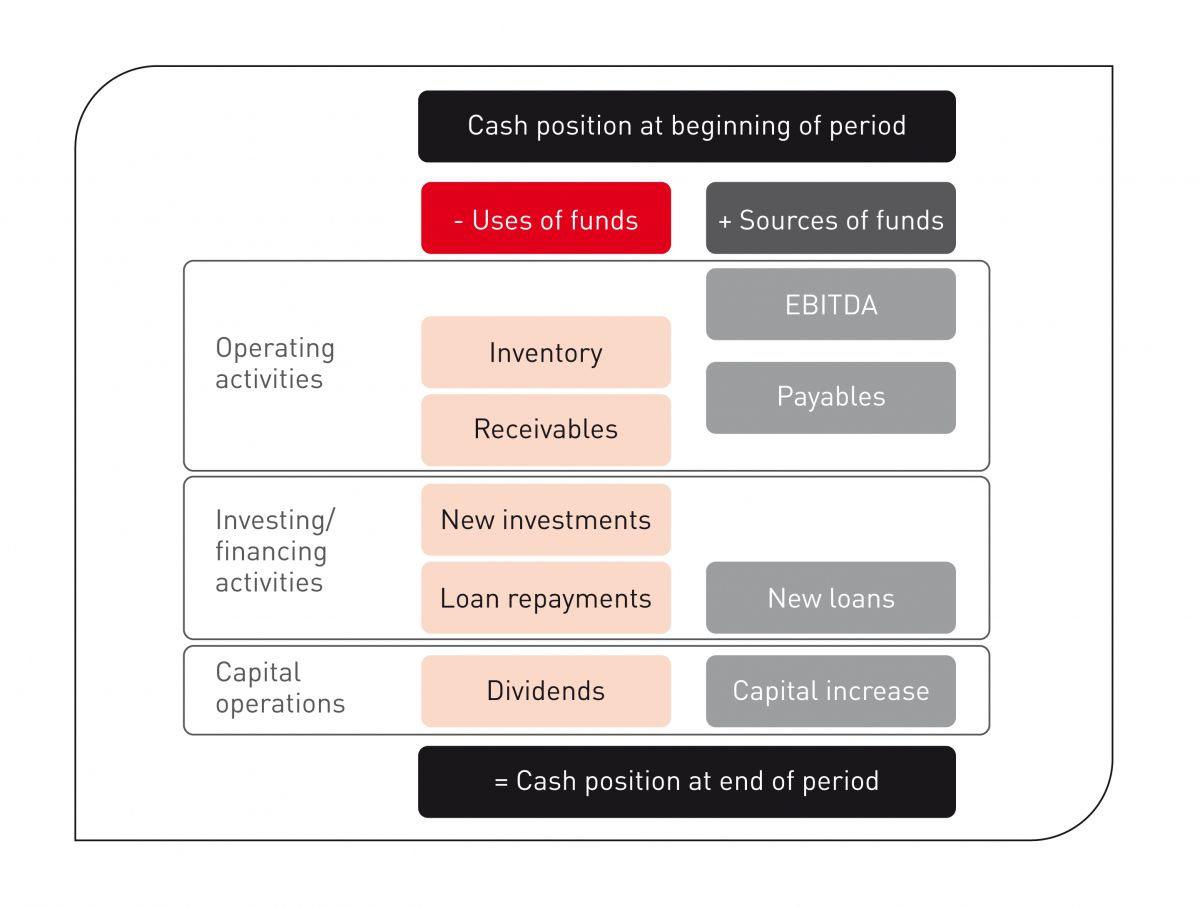
A period (which can be a day, a week, a month, a year…) starts with a certain amount of cash or cash equivalent (short-term deposits…). During this period, on the one hand, several sources will generate funds that adds to the amount of cash held, whilst on the other hand various expenses will deplete the cash. The balance of these operations explains the difference between the amount of money at the beginning of the period and the amount remaining at the end of the same period.
We usually distinguish three different sorts of cash changes:
- Firstly, cash changes coming from operating activities (the normal daily operations in the practice) which impact on the EBITDA; this is usually in payments for services and goods that provide the main daily source of cash, and is affected by changes in the inventory (when purchasing stock) or in liabilities incurred (e.g., utilities, wages) that consume cash.
- Secondly, the cash changes linked to investing and financing activities. For instance, if a new item of equipment is acquired at a cost of 50 K€ and financed with a 50 K€ bank loan, there is no change in the cash held on the day it is bought, but there will be some cash consumed each time we repay a loan installment. Alternatively, if the same item of equipment is purchased without any bank loan to pay for it (by using existing cash held), we will experience a cash decrease of 50 K€ on day 1.
- Finally, cash changes linked to capital operations, when we pay a dividend to owners, partners or shareholders, or when we ask them to add funds in the form of equity or short-term loans.
“Explore every available legal measure to obtain extra cash, such as refinancing existing loans or even leasing back some assets, and applying for special loans offered or backed by the government.”
Cash optimization during a crisis
To be totally clear, during a crisis cash management is only a short-term therapy and any recovery strategy is not based on it, but it sometimes may be necessary, or even vital, to follow the recommendations shown in (Box 2) just to avoid running out of cash.
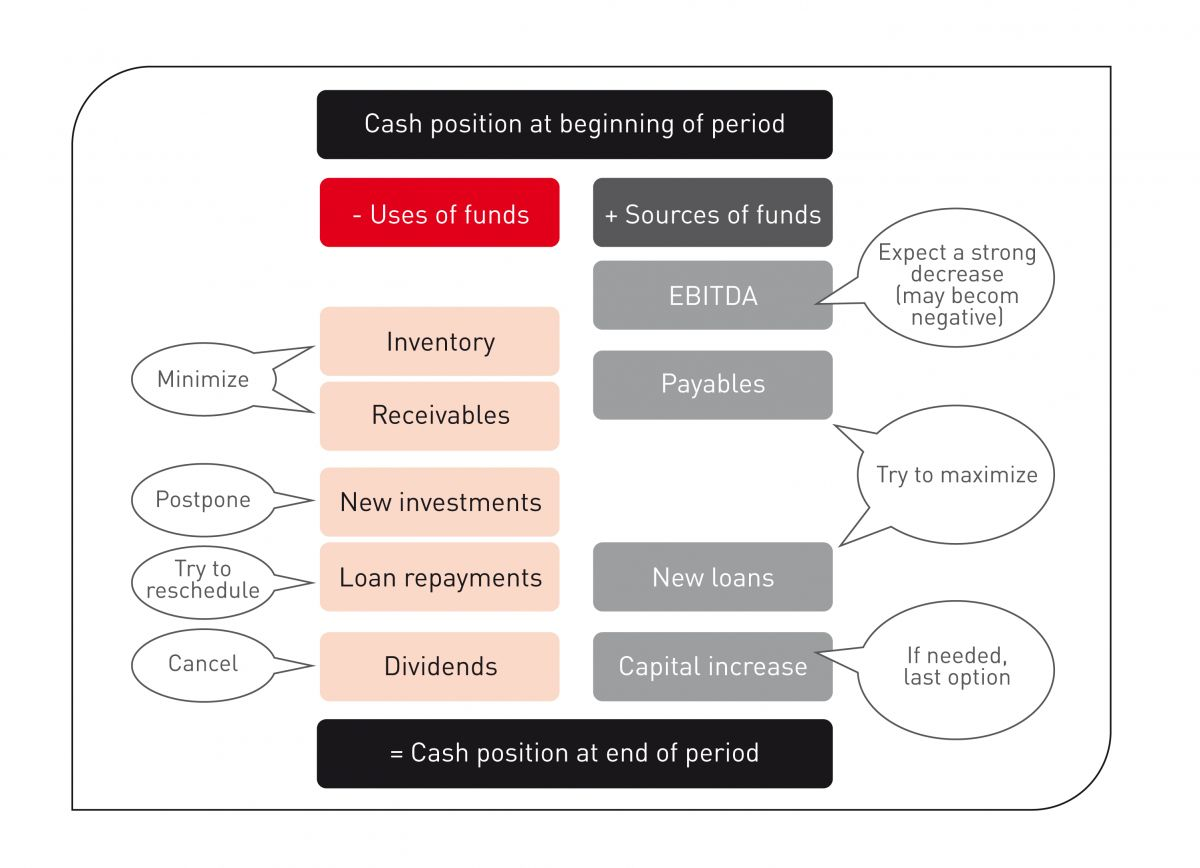
The main recommendations are as follows:

- The starting position is to expect a sharp decrease in EBITDA, even to the point where it is negative. Trying to mitigate this is a key issue and requires income to be kept as high as possible – although the caseload is expected to fall – mainly by working on increasing the average transaction value (ATV).
- Minimize money owed to the business whilst maintaining income as much as possible, i.e., it is wise to implement a “no-credit” policy to ensure the practice gets paid at the time of providing a service (Figure 3).
- Downsize the drug and food stocks, even if this means missing out on some promotions from suppliers, but ensure that the inventory is such that the practice can work normally and sell clients what they want to buy.
- When it comes to settling liabilities, keep the payment delay as short as possible for key partners, including staff salaries (but possibly not the practice owners). Nevertheless, try to negotiate longer payment terms with suppliers. In addition, do not hesitate to use as needed every available extraordinary measure allowed by the government to delay some expenses, such as social insurance payments and taxes.
- Non-essential investments should be postponed.
- Explore every available legal measure to obtain extra cash, such as refinancing existing loans or even leasing back some assets (although this may take some time to be implemented), and applying for special loans offered or backed by the government.
- Finally, if necessary, cancel any planned dividend payments. It may even be necessary to ask shareholders, owners or partners to introduce cash to the business, either as equity or as short-term loans, if the closing balance puts the business at risk.
Recognition of the magnitude of this crisis and the very real threats that it brings to a veterinary business is essential for survival. It must be emphasized that none of the actions discussed above can cure the disease, but they can prove to be decisive in buying time in order to stay alive and implement true solutions until we can benefit from a strong recovery program once the crisis is over.

Philippe Baralon
DVM, MBA
Dr. Baralon graduated from the École Nationale Vétérinaire of Toulouse, France in 1984 and went on to study Economics (Master of Economics, Toulouse, 1985) and Business Administration (MBA, HEC-Paris 1990). He founded his own consulting group, Phylum, in 1990 and remains one of its partners to this day, acting primarily as a management consultant for veterinary practices in 30 countries worldwide. His main areas of specialization are strategy, marketing and finance, and he is also involved in training veterinarians and support staff in the field of practice management through lectures and workshop, as well as benchmarking the economics of veterinary medicine in different parts of the world. A prolific author, he has authored more than 50 articles on veterinary practice management.

Pere Mercader
DVM, MBA
Dr. Mercader established himself as a practice management consultant to veterinary clinics in 2001 and since then has developed this role in Spain, Portugal and some Latin-American countries. His main accomplishments include authoring profitability and pricing research studies involving Spanish veterinary clinics, lecturing on practice management in more than 30 countries, and authoring the textbook “Management Solutions for Veterinary Practices” which is published in Spanish, English and Chinese and has sold worldwide. In 2008, he co-founded VMS (Veterinary Management Studies), a business intelligence firm that provides a benchmarking service for more than 800 Spanish veterinary practices. Dr. Mercader was also a co-founder of the Spanish Veterinary Practice Management Association (AGESVET) and served on its board for eight years.

Lucile Frayssinet
DVM
Dr. Frayssinet is a French veterinarian who graduated from the École Nationale Vétérinaire of Toulouse in 2019. She is currently a consultant in Veterinary Practice Management at Phylum, with a international focus on strategic and marketing issues. She has a particular emphasis on the trend of corporatization in veterinary medicine, both in Europe and worldwide, and was also recently involved with an in-depth survey on the evolution of veterinary demographics in France and Europe.