
Introduction
Informing clients about medical procedures, services and products comes naturally for most veterinarians. It´s when the client asks “How much is it going to be?” that communication often tends to get slightly tricky and uncomfortable, leaving us trying to avoid conflict around fees and prices by granting discounts, by reducing the total cost, (e.g., by not billing for every service delivered) and by generally trying to deflect this sensitive topic. But why is this happening? And how can we change it? This article will offer a quick guide to an easy and stress-free communication of price and costs for all practice team members.
First steps
To help find solutions for comfortable discussions on price, it helps to begin by asking ourselves some questions:
- Why are we often uncomfortable when talking about costs to our clients?
- How can we effectively overcome this feeling of discomfort?
- Which tools can help us to act as confident professionals in every aspect of client communication?
The answers are perhaps easier than you might expect!
Reframe the veterinary mindset
It seems that a historical paradigm affects the entire sector, or at least for the majority of veterinary professionals worldwide: It says that clients actually don´t want to pay (much) at the veterinary practice. Sadly, this paradigm greatly affects how we interact with our clients, because an assumption like this can be a real hurdle for our business, preventing us from offering owners the best we can deliver by focusing on their needs, instead of constantly thinking about the client´s purse.
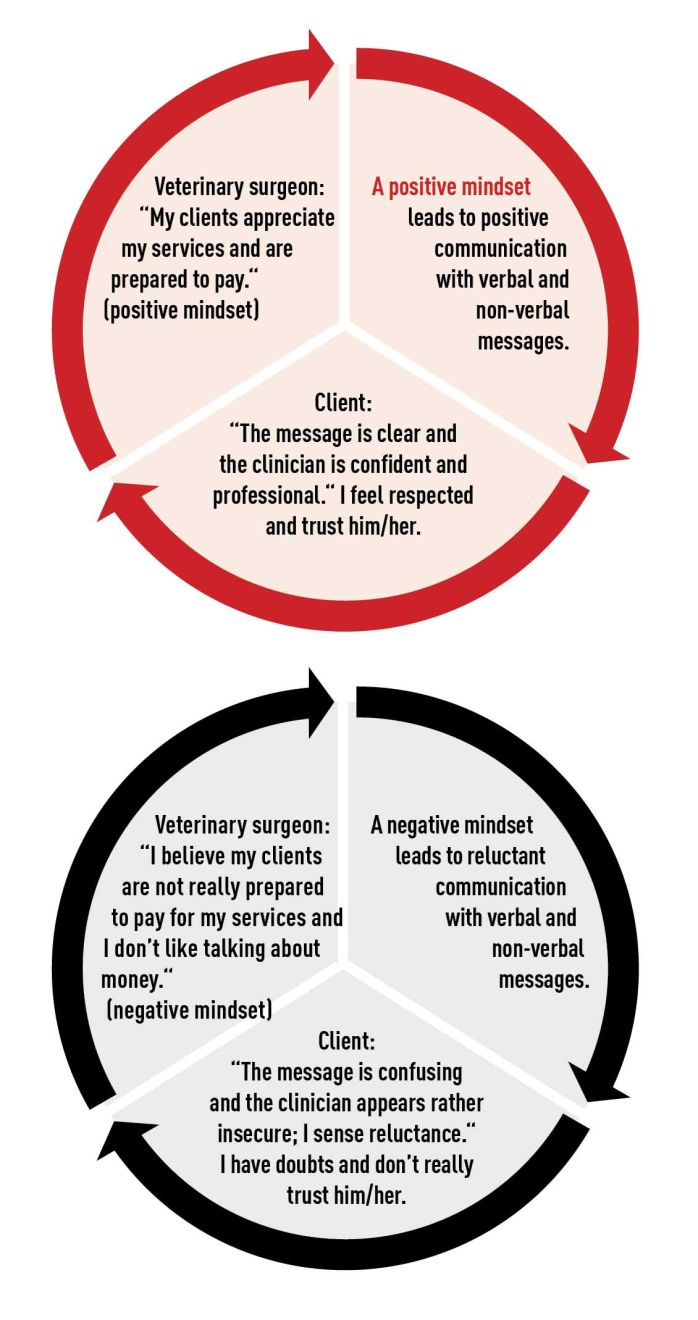
Taking a mental step back and analyzing the assumption that clients are unwilling to pay for our professional services, it´s clear this attitude makes no sense at all. Why? Because every client and customer are fully aware that the act of buying something always involves a fee – even at the veterinary practice. This is also confirmed by the VMS study from Pere Mercader, which proves pet owners don´t necessarily prefer lower prices and don´t think about prices as much as we believe. And do not forget: the strength of the human-animal bond will mean that the pet-owner´s mindset is such that they want to take good care of their beloved family members, and of course this includes getting the best veterinary services. If owners are fully informed and understand the benefits and value of services and products for their pets, they are usually fully prepared to pay their bills (Figure 1).

Be aware of self-fulfilling prophecies
Sadly, a negative mindset (e.g., “my clients don´t like to pay”) often leads to exactly the reaction we want to avoid: the pet owner is reluctant to pay and shows signs of discomfort when the veterinary professional talks about services. This often results from the devastating impact of the so-called self-fulfilling prophecy: if we think that clients are generally reluctant to pay our fees, we then unconsciously display this mindset in our body language, rhetoric and the way we construct our dialogue (often avoiding the issue of payment). This leads to a client receiving an impression of our discomfort on an unconscious level, and then reacting consciously by saying things like “I have to think about that” or “I’m not sure that this is a good idea”. When this happens, we feel affirmed in their belief that clients don´t like to pay, but we are not aware that it was our very own mindset that led to clients mirroring our discomfort and having second thoughts about saying “yes” to services and products offered. The conclusion is that we then recognize the client’s reluctance and think: “I knew it! They don´t want my services!”
Therefore, it is often our inability to generate a positive and structured approach to speaking about cost that leads to the conflict itself – a beautiful example of a self-fulfilling prophecy. The assumption (and sometimes even expectation) that clients won´t pay leads to the clinician displaying controversial and negative body language and an avoidance of the topic, resulting in a reluctant client who starts to have doubts about the treatment that is being recommended.
So to emphasize – the starting point of the problem is not at the client’s end, it´s the veterinary professional´s “prophecy” aided by his or her false assessment of the client, that fulfils itself. The most important thing needed to overcome our discomfort and to tackle self-fulfilling prophecies when discussing fees is to reframe our mindset by adopting a positive attitude that says: “Of course my clients are totally prepared to pay an appropriate fee for the services received at my clinic” (Figure 2).
Create protocols to help you and your team
From the above, it´s clear that our profession has to focus on a positive mindset and find the tools that help defuse the discomfort around the issue of costs and price in client communication. And one of the most effective ways to tackle the “when and how” in everyday practice is to create a protocol for informing clients about costs: develop a structure that is tailor-made for you, your team, and your business, and that defines when and who talks to your clients about the costs. Answering the following questions can help you construct a written protocol for this, which can be shared and discussed within your team, and then installed as a “must-do” into your client-communications:
- When’s the best time point to mention costs during the consultation? Reflect on your habits and try out several possibilities. The author believes that the issue of price is best included directly when talking about the respective services and/or products. This way the client feels respected, informed and secure and won´t be surprised when checking out of the clinic. The other advantage of this approach is that it offers the chance to adapt the treatment plan (if the client says they can´t afford it) and to answer questions that arise before starting a course of treatment.
- Who should talk about money? This clearly depends on the services and products that are presented. If clients want to know the price of something (e.g., an antiparasitic check and deworming medication) it does not have to be the veterinarian that give the answer – educated and trained staff can handle this, especially if there is a protocol for which information is to be given on certain services and products (Figure 3). Medical procedures, diagnostics and complex treatment and preventive healthcare plans, plus their respective costs, should be explained by the clinician, because they have more insight on these matters and are able to handle all questions professionally. Of course, they should also be trained on how best to create value by presenting medical options and preventive measures in a client-focused and easy to understand manner, helping owners to make informed decisions.
What to avoid?
Finally, let’s list some things that should be avoided when talking and/or discussing costs with clients:
- Don´t let clients apply emotional pressure when the conversation involves money. Some clients may try to lower your fees by saying things like “I thought you loved pets and want to help them, so why are you so expensive?” Stick to and express your (new) mindset when diffusing this attempt at emotional blackmail by answering: “You are right. I love pets and love helping them get better and stay well. This is why I’ve built this clinic with devoted staff and the best equipment to focus on the needs of your pet. Of course, this investment has to be shared by the clients that consult us. But be assured, we calculate our fees in a fair and appropriate manner in line with existing laws and guidelines of our profession.”
- Don´t try to justify your fees by summing up the costs incurred to run and maintain the clinic. These may be the exact same arguments that pet owners use to explain why they don´t have enough money – they have to pay for rent, energy supplies, transportation, food, clothing, etc. Focus on your fairly calculated fees and point out the value that clients (can) get at your office.
- Don´t give in to clients that pressure you, e.g., by lowering your fees. This will spread through the pet owner community (e.g., via social media!) and set an example for other clients, eventually leading to an increasing number of owners that appear at your clinic having heard that you have a “big heart” when it comes to money.
It’s important to avoid preconceived ideas about what a pet owner can or cannot afford.
Conclusion
Whether we are the business owner or an employee, the entire veterinary team needs to know how to discuss financial aspects of pet care with owners, know why fees are set at a certain level, and know how our clients perceive their transactions at the clinic. Veterinary fees do not have to be a headache for the veterinary business, but we cannot and should not ignore this vital aspect of our work – after all, a profitable business means that the staff are well paid, new equipment can be purchased, and the practice can flourish.

Antje Blättner
DVM
Dr. Blaettner grew up in South Africa and Germany and graduated in 1988 after studying Veterinary Medicine in Berlin and Munich. She started and ran her own small animal practice before undertaking postgraduate training and coaching course at the University of Linz, Austria and then founded “Vetkom”. The company provides training to veterinarians and veterinary nurses in practice management in subjects such as customer communication, marketing and other management topics. Dr. Blaettner also is editor for two professional journals, “Teamkonkret” (for veterinary nurses) and “Veterinärspiegel” (for veterinarians).