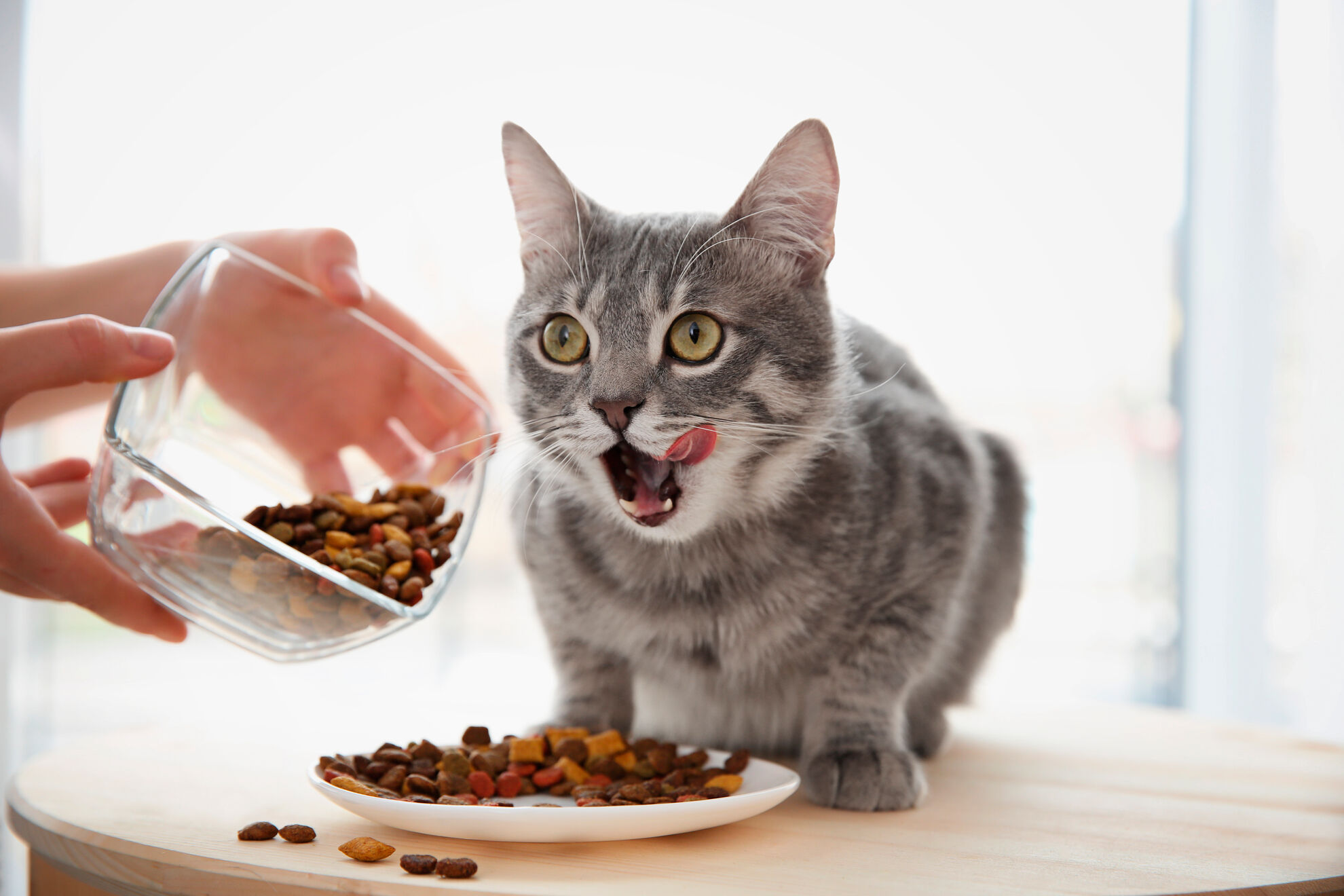
Chronic kidney disease (CKD) is one of the most common pathologies in elderly cats, with more than 30% of individuals over 15 years of age affected [1]. This condition is often accompanied by eating disorders, and yet maintenance of bodyweight in cats with CKD is positively correlated with their lifespan [2]. The palatability of renal diets is therefore a key element in the nutritional management of this disease.
Palatability
Palatability is a complex, multifactorial phenomenon which encompasses not only the characteristics of the diet (odor, taste, texture, nutritional composition, etc.) (Table 1), but also those of the animal and its environment (perception of the food, experience, etc.). Indeed, dietary preferences vary enormously from one individual to another [3][4].
| Ingredients |
The nature of the chosen ingredients (proteins, fats, etc.) and how they are
sourced must be optimal. Certain ingredients, known as palatants, can be added to improve the taste.
|
| Processing |
The processing parameters should be optimized to ensure attractive
ingredients and textures.
|
| Preservation |
The preservation systems and packaging must be adequate to ensure
product freshness.
|
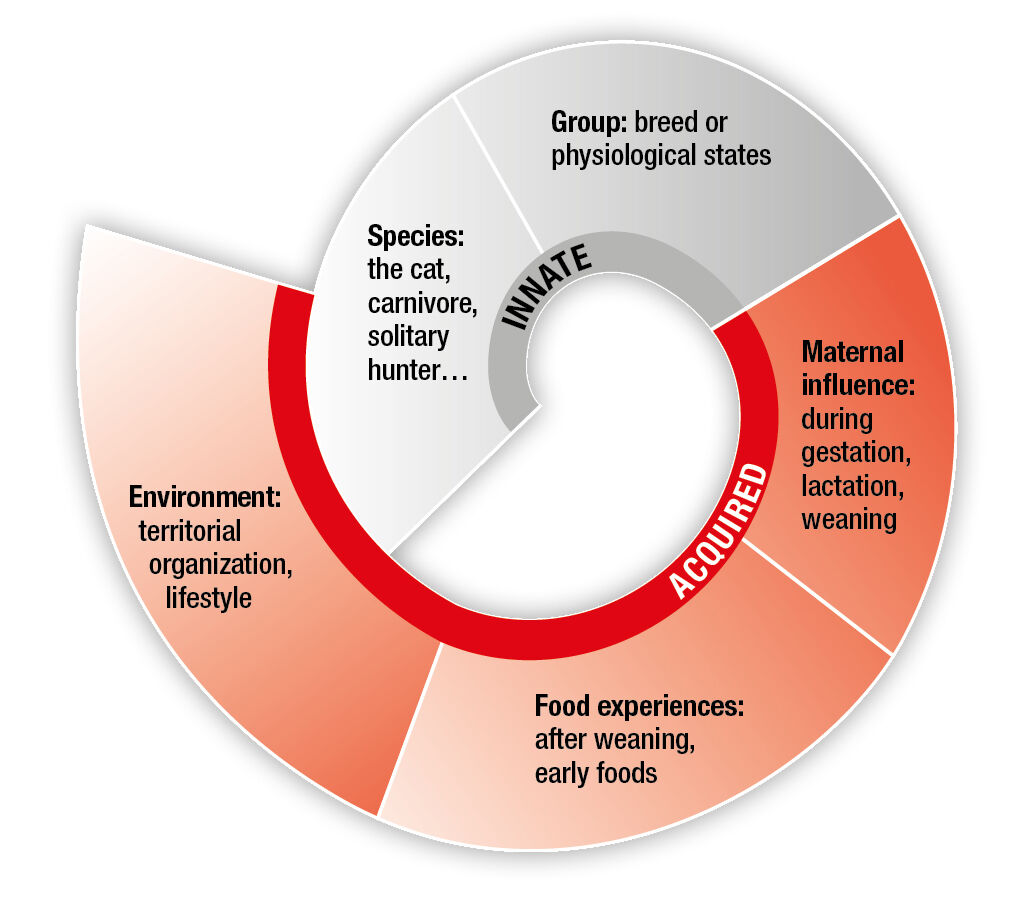
Some preferences are innate and may be linked to breed, anatomy [5], or individual genetics. Others are acquired over the animal’s life – for example, perinatal experiences have a major impact on future dietary choices [6] (Figure 1). Furthermore, different cats may react differently when presented with a foodstuff depending on previous experiences. These reactions can include a neophilic or neophobic response (i.e., attraction to, or repulsion by, novel diets), an anti-apostatic response (preferring foods that are not novel but are rarely offered) [7], apathy, or aversion. It is therefore essential to take the animal and its individual preferences into account when optimizing the palatability of a product. This is particularly important for cats with CKD.
Palatability is a complex, multifactorial phenomenon which encompasses not only the characteristics of the diet, but also those of the animal and its environment.
The cat with CKD
Cats with CKD often exhibit dysorexia: 40% suffer from hyporexia, and 15% from complete anorexia [8]. Importantly, cats are genetically predisposed to correlate gastrointestinal discomfort after a meal with the food ingested immediately prior to this event, and they are more likely to refuse to eat that particular food in future [9]; both the taste and the odor of the product may be recognized and associated with the discomfort. The learning process is both quick and persistent, such that a single ingestion of a particular food can lead to lasting refusal. The nausea and vomiting experienced by CKD cats may therefore engender this type of reaction, so it is important to be able to offer an alternative food which both preserves the required nutritional strategy to manage CKD and offers a new sensory profile (odor, taste, texture) that differs from the previous diet, and that the animal finds appealing.
The nutritional constraints (low phosphorous levels and protein restriction) necessary for renal diets have a major impact on their palatability. However, these constraints are essential for good nutritional management of CKD, and dietary experts must therefore rely on their knowledge of the above parameters to make the food attractive and offer alternative solutions to the problem of aversion or reduced consumption.
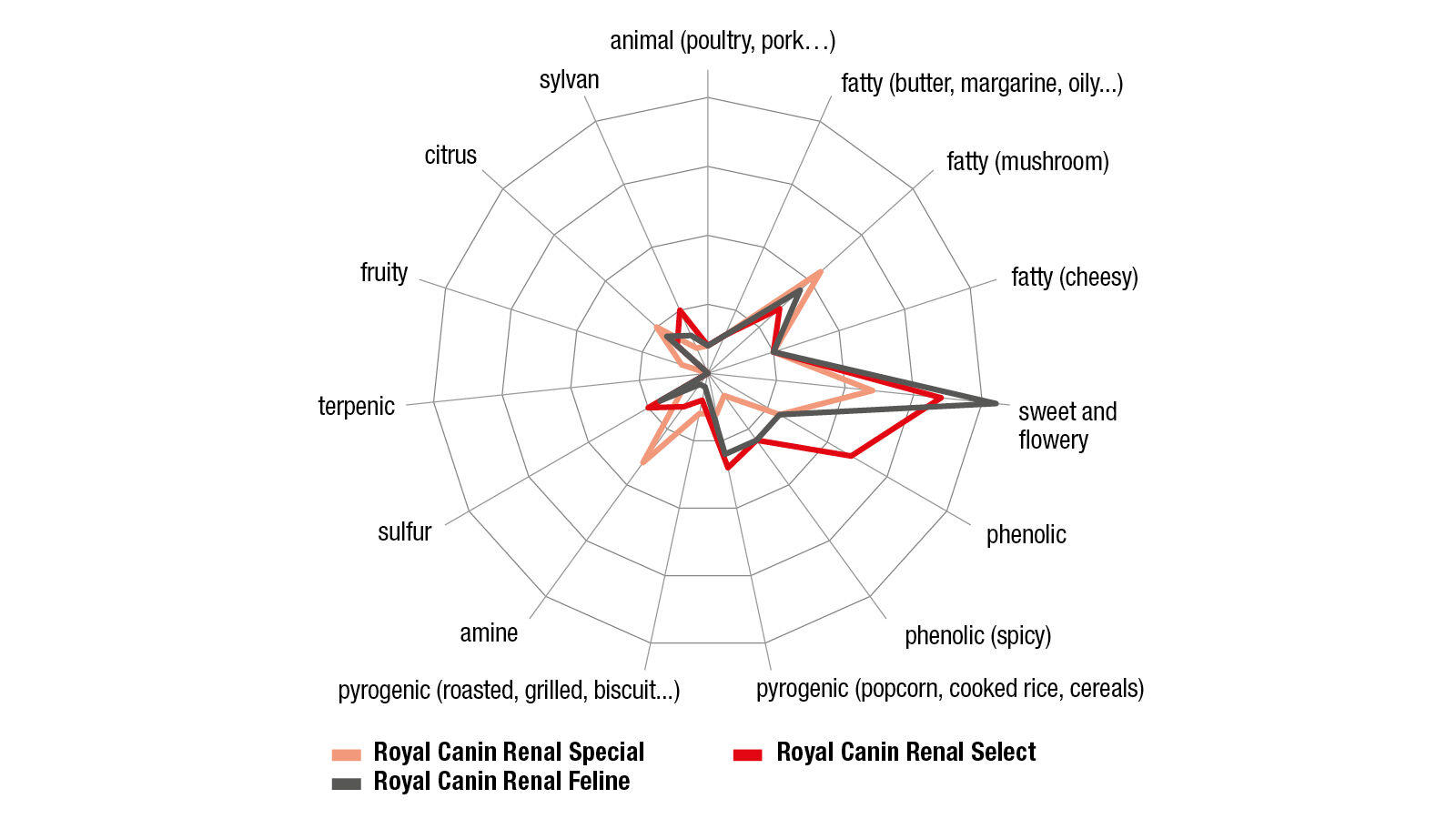
With this knowledge, Royal Canin has recently developed a range of new renal diet products. These have been formulated using products that are perceived to be different by the cat, so if there is food aversion or decreased intake with one particular diet, it is possible to offer another product from the range to improve consumption. A clinical trial on 18 cats with CKD demonstrated that this organoleptic approach made it possible to offer an effective solution to appetite problems and to satisfy individual dietary preferences whilst supplying the required nutritional support [10](Figure 2).
Astrid Le Bozec
MS (Chem), MS (Food flavors)
Astrid Le Bozec studied chemistry at the ENSIACET (École Nationale Supérieure des Ingénieurs en Arts Chimiques et Technologiques) in Toulouse, France, which included six months in the Food Science department at the Iowa State University, and graduated in 2007. She then specialized in food flavors and achieved a professional Masters degree in 2008 at the ISIPCA (Institut Supérieur International du Parfum, de la Cosmétique et de l’Aromatique) in Paris. Astrid has been in charge of the palatability research program at Royal Canin since 2009.
References
- Adams LG. Phosphorus, protein and kidney disease. In: Proceedings. The Petfood Forum 1995;13-26.
- Royal Canin clinical internal study in collaboration with 12 veterinary clinics and 1 university, France, UK and Switzerland 2014.
- Jaubert JN, Tapiero C, Dore JC. The field of odors; towards universal language for odor relationships. Perfumer Flavorist 1995;20:1-16.
- Parker VJ, Freeman LM. Association between body condition and survival in dogs with acquired chronic kidney disease. J Vet Intern Med 2011;25:1306-1311.
- Bradshaw JW, Healey LM, Thorne CJ, et al. Differences in food preferences between individuals and populations of domestic cats Felis silvestris catus. Appl Anim Behav Sci 2000;68:257-268.
- Rogues J, Forges C, Niceron C. Satisfaire les préférences individuelles des chats. In: Proceedings. 3e Symposium International d’Ethologie Vétérinaire SEEVAD 2015;10.
- Royal Canin internal study in collaboration with ENSAM (Ecole Nationale Suprieure des Arts et Mtiers) and EMA (Ecole des Mines dAls), France 2002.
- Becques A, Larose C, Gouat P, et al. Effects of pre- and postnatal olfacto-gustatory experience on early preferences at birth and dietary selection at weaning in kittens. Chem Senses 2010;35:41-45.
- Church SC, Allen JA, Bradshaw JWS. Anti-apostatic food selection by the domestic cat. Anim Behav 1994;48:747-749.
- Queau Y. Impact of renal failure on the gastrointestinal tract and food intake. In: Proceedings, 21st ECVIM-CA Congress 2011.
- Bradshaw JW, Goodwin D, Legrand-Defretin V, et al. Food selection by the domestic cat, an obligate carnivore. Comp Biochem Physiol 1996;114:205-209.